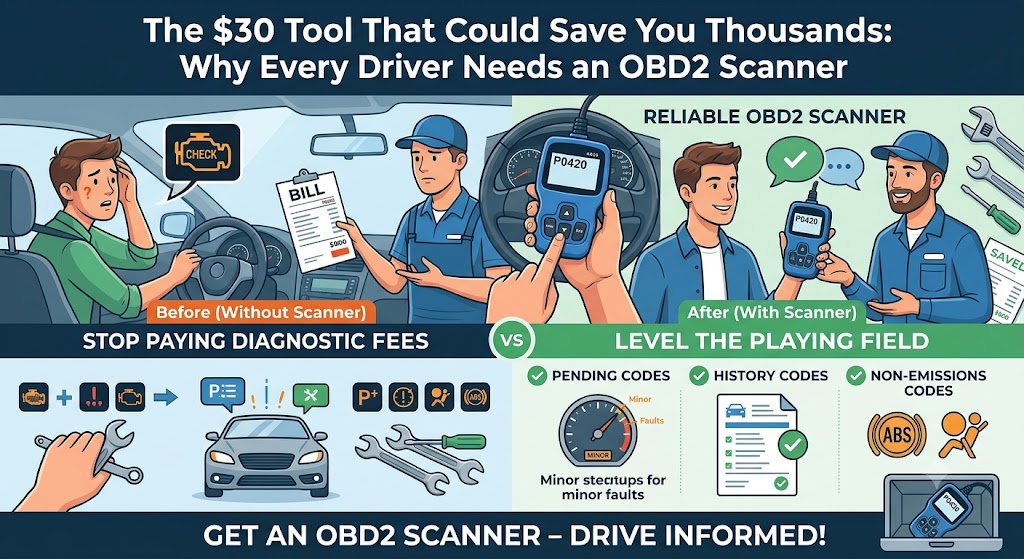
Every driver needs an OBD2 scanner because it provides instant vehicle diagnostics that can prevent expensive repair bills and identify hidden mechanical issues before they become serious. This affordable tool allows owners to troubleshoot check engine lights at home, verify a used car's health before purchase, and determine if a simple DIY fix is possible. Understanding why every driver needs an OBD2 scanner ensures long term vehicle reliability while saving time and money on professional diagnostic fees.
Few sights provoke as much immediate anxiety as the illumination of a check engine light during a morning commute. Traditionally, this amber glow signaled an inevitable trip to the dealership, where a technician would charge upwards of one hundred dollars just to plug in a computer and read a code. At Auto Audit Advisors, we believe that every driver deserves a direct line of communication with their vehicle to avoid these unnecessary diagnostic paywalls. This modest investment transforms a stressful mystery into actionable data, allowing you to approach repairs with professional confidence. In this guide, we will analyze why the OBD2 scanner is an essential asset for modern car ownership. You will discover how to bypass dealership fees, identify hidden mechanical issues during used car inspections, and select the optimal device for your technical comfort level. Empowerment starts with information; it is time to take control of your dashboard.
The Diagnostic Paywall: Why Every Driver Needs an OBD2 Scanner Today
Modern vehicles are essentially rolling computers. When the Check Engine light illuminates, it often triggers immediate anxiety about impending repair costs. However, the true barrier to a fair repair is the diagnostic paywall. Dealerships and service centers frequently charge between $100 and $400 just to plug in a tool and read the fault codes, effectively charging you for information the car is already providing. This is why every driver needs an OBD2 scanner; it acts as a personal black box interpreter that translates cryptic electronic signals into actionable data.
At Auto Audit Advisors, we frequently review service invoices where these diagnostic fees are either explicitly billed or strategically hidden within the labor costs of the repair. By owning a basic scanner, which typically costs around $30, you reclaim control over the transaction. Instead of walking into a service department with a vague sense of dread, you arrive armed with a specific Diagnostic Trouble Code (DTC). This shifts the power dynamic from a passive consumer to an informed owner who understands the technical health of their vehicle.
A personal scanner is your first line of defense for avoiding dealership markups and unnecessary service recommendations. It allows you to verify if a fault is a critical engine failure or a simple fix, such as a loose gas cap or a fouled oxygen sensor. Our expert negotiation services rely on this type of hard data to protect clients, but the process starts the moment you plug that tool into your dashboard. If you have questions about how these tools fit into your vehicle strategy, you can contact Auto Audit Advisors for personalized guidance.
Stop Overpaying: Avoiding the Dealership Diagnostic Fee
The financial impact of owning a scanner becomes apparent the first time your dashboard lights up. Often, the cause of a Check Engine light is a minor issue that requires a few minutes rather than a few hundred dollars. For instance, an evaporative emission code is frequently triggered by nothing more than a loose or cracked gas cap, a part costing less than $20 at any Twin Falls auto parts store. Without your own tool, you might pay $150 just for a service advisor to tell you to tighten the lid.
Auto Audit Advisors prioritizes diagnostic fee transparency when reviewing service quotes for our clients. We see these charges as a friction point that often prevents owners from seeking necessary maintenance. By performing your own scan, you eliminate the middleman and the associated markup.
Service Provider | Typical Diagnostic Fee | Ongoing Financial Impact |
|---|---|---|
DIY Scan | $0 (After initial $30 tool) | Pays for itself in one use |
Local Mechanic | $80 to $120 | Recurring cost for every issue |
Dealership | $150 to $400 | Highest barrier to entry for repairs |
When you understand why every driver needs an OBD2 scanner, you realize it is an investment in financial sovereignty. Instead of handing over a blank check, you use data to drive the conversation. If the scan reveals a fouled sensor, you can decide to replace it yourself or use our expert negotiation services to ensure the shop doesn't inflate the labor time. This level of preparation is the foundation of avoiding dealership markups on routine repairs. If you are unsure how to interpret your results, you can always contact Auto Audit Advisors for professional assistance.
The Used Car Buyer's Secret Weapon: Spotting Hidden Codes

In the used car market, a clean dashboard can be a calculated deception. Unscrupulous sellers, including some independent dealerships, use a simple trick to move problematic inventory: they clear the Diagnostic Trouble Codes (DTCs) minutes before a potential buyer arrives. This turns off the Check Engine light, providing a temporary window of perceived reliability that usually lasts just long enough for the test drive to conclude and the check to clear. This specific risk is why every driver needs an OBD2 scanner during the shopping process; it allows you to see the history the seller is trying to erase.
To bypass this deception, you must look at the I/M Readiness or Emissions Monitors status on your scanner. After a vehicle's computer is reset, it must complete a specific series of driving patterns, known as a drive cycle, to verify that various systems like the catalytic converter and evaporative system are functioning correctly. If you plug in your tool and see multiple monitors listed as Not Ready or Incomplete, it is a massive red flag. It indicates the computer was recently wiped, and the car has not been driven enough to confirm the absence of major engine or transmission faults.
At Auto Audit Advisors, we utilize these scans as a cornerstone of our remote pre-purchase inspections. When we represent nationwide clients, we demand a live look at these readiness monitors to ensure a seller isn't hiding a $3,000 transmission failure behind a cleared code. This data provides the leverage needed for expert negotiation services or, in many cases, the evidence required to walk away from a bad deal entirely. By verifying the permanent codes that remain stored even after a basic reset, we help our clients in avoiding dealership markups on vehicles that require immediate, expensive repairs. If you are evaluating a vehicle and the seller refuses to let you perform a scan, contact Auto Audit Advisors immediately; a refusal is often just as informative as a failing code.
Choosing the Right Tool: Bluetooth Dongles vs Handheld Scanners
Once you understand the strategic advantage of monitoring readiness status, the next step is selecting the hardware that best fits your workflow. The consumer market is primarily split between wireless Bluetooth dongles and dedicated handheld scanners. Each has distinct advantages depending on whether you want deep technical analysis or a simple, foolproof interface.
An OBD2 scanner bluetooth dongle, such as the widely available ELM327, is a compact device that syncs with an OBD2 scanner app like Torque, Car Scanner, or BlueDriver. This setup is the gold standard for live data streaming. It allows you to monitor parameters like fuel trims, coolant temperature, and oxygen sensor voltage in real-time on your smartphone. Because these apps receive frequent updates, they often provide more detailed definitions for manufacturer-specific codes than a budget handheld tool would.
Handheld scanners are dedicated units with a built-in screen and cable. These are preferred for their plug and play reliability; they do not require pairing, phone battery, or software downloads. When choosing between these options, prioritize features like ABS and SRS (airbag) coverage. Many entry-level tools only read powertrain codes, but identifying a faulty airbag clock spring or a failing ABS wheel speed sensor is vital for safety and for avoiding dealership markups on complex electronic repairs.
Feature | Bluetooth Dongle + App | Handheld Scanner |
|---|---|---|
Portability | High (Pocket-sized) | Medium (Requires cable) |
Data Visualization | Excellent (Graphed on phone) | Basic (Text-based) |
Setup Time | 1-2 minutes for pairing | Instant (Plug and play) |
Reliability | Depends on app/phone | Extremely High |
Crucially, ensure your chosen tool can read "pending" codes. These are faults the vehicle has detected but has not yet confirmed with a dashboard light. Identifying these early is a core part of the expert negotiation services we provide, as it allows you to address a looming issue before it becomes a breakdown. While professional-grade workshop scanners often require expensive annual subscriptions, the tools recommended for daily drivers are one-time purchases with no recurring costs. If you are overwhelmed by the options available on the market, you can contact Auto Audit Advisors to discuss which tool best suits your specific make and model.
How to Use an OBD2 Scanner in Three Simple Steps
Understanding how to use an OBD2 scanner reinforces why every driver needs an OBD2 scanner in their glovebox; it provides instant, objective clarity without requiring a mechanical background. The process follows three tactical steps to extract the data you need for a fair transaction.
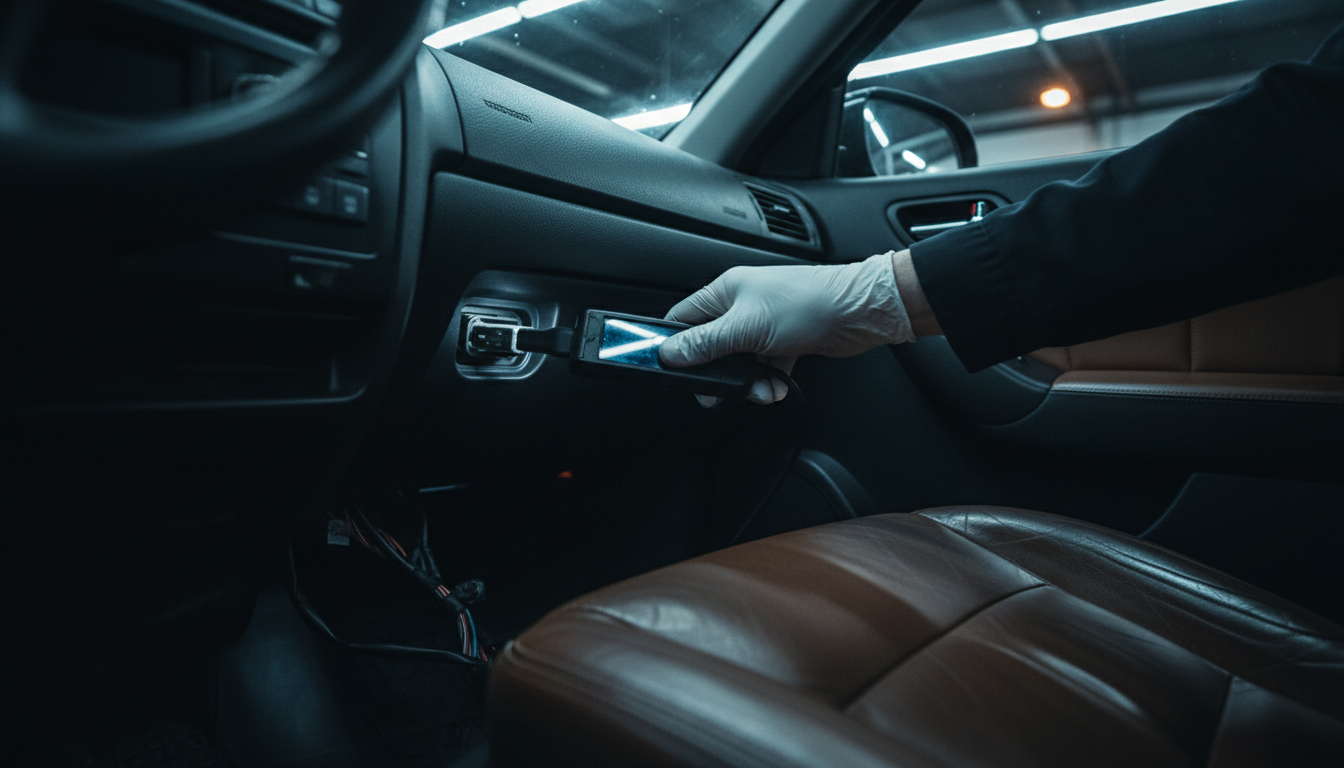
Locate the Port: Every vehicle manufactured after 1996 features a 16 pin Data Link Connector. This is typically found under the driver side dashboard, often near the steering column or tucked just above the brake pedal. If it is not immediately visible, check behind small plastic trim panels.
Establish the Connection: Firmly plug the scanner into the port. Turn your ignition to the 'On' position without starting the engine. This powers the scanner and wakes up the vehicle's computers to share data. If you are testing for live misfire data, you may eventually need to start the engine, but the initial scan is done with the engine off.
Retrieve the DTC: Select 'Read Codes' on your device. You will receive an alphanumeric Diagnostic Trouble Code (DTC), such as P0420. The first letter identifies the system, such as P for Powertrain, while the numbers pinpoint the specific component failure.
Once you have the code, use a reputable online database to identify the likely culprit. This information is vital for avoiding dealership markups on unnecessary parts or labor. If you are scanning a vehicle before a purchase and see codes you do not understand, contact Auto Audit Advisors to leverage our expert negotiation services for a safer, more transparent transaction.
Empowering Your Negotiation with Hard Data

Armed with a specific DTC, you fundamentally change your position at the negotiation table. Most vehicle transactions favor the seller because of information asymmetry; the dealer knows the car's history, but the buyer only knows what they are told. Presenting a screenshot of a pending P0300 random misfire code immediately signals that you are an informed participant who cannot be easily misled. This shift in power illustrates why every driver needs an OBD2 scanner in their arsenal; it turns a high-stakes conversation into an objective review of facts.
This technical clarity is essential for avoiding dealership markups on unnecessary service items like transmission flushes or vague engine refreshes that do not address the root cause. When a seller realizes you have scanned the vehicle, the conversation moves away from sales tactics and toward mechanical reality. If you identify a pending fault that hasn't yet triggered a dashboard light, you can demand a price concession or a verified repair before signing any paperwork. This data-driven approach is the core of how Auto Audit Advisors assists clients. Our expert negotiation services rely on this objective evidence to strip away hidden costs and streamline the transaction process. By utilizing your own data, you secure a better financial outcome and ensure the dealer remains accountable. If you encounter a complex code during your scan, contact Auto Audit Advisors to help translate that data into a winning strategy.
Common Questions About Car Diagnostic Scanners
The OBD2 standard was mandated for all light duty vehicles sold in the United States starting in 1996. This means nearly any car on the road today, regardless of brand, is compatible with a universal scanner. This uniformity is a major reason why every driver needs an OBD2 scanner; it is a tool that remains relevant even after you trade in your current vehicle for a newer model.
You are absolutely permitted to bring a code reader to a dealership or a private sale. Doing so immediately signals that you are monitoring the vehicle's health independently. While some dealerships may offer to waive a diagnostic fee if you agree to perform the repair with them, this is rarely an altruistic gesture. The cost is often simply redistributed into the labor rate or parts markup. By performing your own scan, you retain the leverage needed for avoiding dealership markups because you aren't reliant on their service advisor for the initial truth.
It is important to distinguish between active, pending, and permanent codes. While a basic scan tool can clear a Check Engine light, modern onboard computers store permanent codes that cannot be erased with a simple reset. These only clear once the computer verifies the fix through a successful drive cycle. If you encounter a vehicle where the light is off but the monitors are not ready, the seller has likely cleared the history recently. Identifying these patterns is how our expert negotiation services protect buyers from purchasing hidden problems. If you have questions about specific readings or need help interpreting a complex report, you can contact Auto Audit Advisors for a professional review of your diagnostic data.
An OBD2 scanner is a simple, affordable tool that provides essential clarity before you ever visit a mechanic. By understanding your vehicle's health, you can avoid unnecessary expenses and make informed decisions. While these devices offer a great starting point, interpreting complex data often requires a more nuanced perspective. If you want expert help navigating these technical details or need professional guidance on your next vehicle purchase, feel free to learn more about our mission and how we can support your automotive journey.